Tag Archive for: Music

Your first song release

by Bianca Fachel


1. Start locally

Share your work with community radio, local papers. Apply for grants in your local Arts Office.


2. Become a member of IMRO

The Irish Music Rights Organisation are in place to ensure artists receive royalties from their music being

  • publicly performed live
  • broadcasted
  • made available online


Membership is free with lots of artist supports.

Visit IMRO’s website, and if you need anything else that is not covered in the website do call them, they will help you out.


3. Copyright is automatic when you write & publish a song online.

In Ireland (and under the Berne Convention), copyright exists automatically upon creation and fixation. Publishing online simply provides readily accessible, dated evidence of that creation, which is invaluable if you ever need to defend your ownership.


4. Digital Distributors get your music onto streaming services


5. A stream counts when someone listens for 30 seconds


6. Some platforms don’t give you a fixed amount per stream

Spotify, for example, pays you based on how many times your song is listened to compared with bigger songs.


7. Connect with other artists.

Sharing your experiences with like-minded people is important – it is challenging working solo on a passion project.

Other artists can also provide new opportunities, like collaborations.


8. Make sure your day job is related to music

Starting off, you’ll likely need to make money elsewhere. Try to ensure your day job is related to music. Maybe it’s in a venue, or somewhere that gives you inspiration for your art. Again, being surrounded by like-minded people is important. It takes time, but if you plant seeds day by day you will certainly have a nice harvest!


Essentials of Songwriting

by Richey McCourt


1. Give yourself as many opportunities to be creative as possible.

In doing this, you’ll identify obstacles in your way in any given week.

What is getting in the way of you sitting down and being creative? Once you identify these obstacles, they’ll become easier to manage and overcome.


2. Always have your antennae out for new ideas.

Be open-minded when you’re watching films, TV, or during conversations. You never know when a great concept, melody or lyric idea will strike you.


3. Being time efficient & organised, leaves more room for creativity.

Consider using new tools to make your more menial tasks quicker to complete.


Voicenotes

Voicenotes are great, now start rating each recording. Each time you record a musical idea to your phone, rate it: 1 star for good, 3 stars for great. This will save you time when you go back through your voicenotes.


RhymeBrain

This is one of many rhyming resources available. Cole Porter is one of the greatest songwriters of all time. He used to carry rhyming dictionaries around with him. If it’s alright for Cole to use them, it’s alright for us.


Splice: a large catalogue of royalty-free samples.


Suggester: a phone app to help you find chords that work well together.


Samply: great for producers when sending mixes and songs to clients.


Session Studio

By Max Martin, Björn Ulvaeus from ABBA, and Niclas Molinder. This helps you clear your songwriting splits more efficiently. It makes it easy to send metadata to labels, such as the key, BPM, lyrics.


Disco

Great if you have a catalogue of songs you want to get in front of music supervisors in a professional setting. It’s standard amongst the TV/Film syncing industry. It also makes it easy to send playlists to A&R people.


Soundflow

For producers, this streamlines a lot of the menial tasks in your Digital Audio Workstation. If something repeatedly takes you 10 clicks, Soundflow enables you to do it in one. This will help you get the time-wasting tasks out of the way.


4. Ask yourself what kind of songwriter you want to be.

If you had a magic wand and you could get your dream record deal or publishing deal, what does that look like?

A lot of people know they want to be a songwriter but haven’t asked themselves that practical question. If you’re taking time out of the week to hone your craft, you can’t be wishy-washy about your objective. Consider the below questions:

  • Are you an artist-songwriter singing your own songs?
  • A songwriter for hire?
  • Both the above?
  • What does your market look like?

If you figure this out, the path will be clearer.


5. Rewrite & be a good editor.

Often you need to be bold and say, “we need new lyrics”, or “we just need to start again.”

Your first draft is the first step. In a writing session you have to leave no stone unturned. Refine, refine, refine, refine. Draw every ounce out of a melody. Don’t settle for OK.

If you feel like you’re internally coming up with excuses for why a certain section isn’t right,  you need to go back and work on it. Maybe the first half of the song needs to be repeated? 90% of the time asking yourself questions like this results in a better song.


6. Don’t be afraid of repetition.

Carly Rae Jepson’s hit, I really like you is a great example of how repetition surprisingly works really well:

“I really, really, really, really, really, really like you

I really really really like you”


7. Let a song marinate.

Give it a break for a few weeks and when you go back, you’ll hear straight away what you need to do to it.


8. The most simple melody or riff is often the best.

Example: The Weekend – Blinding Lights riff

Think of ways to create something to anchor your song around, perhaps a lyrical phrase or a riff. You want to grab the listener with a simple hook.

As Sinéad O’Connor said about songwriting:

“It’s much harder to be simple than

it is to be complicated.”


9. Get in the room with good songwriters.

This will push you in your game. Collaborating will make you consider things you haven’t considered before.


10. Define what your song is about.

Perhaps it’s about the split second you meet someone on the dancefloor. Everything in the song should lead up to, and emphasise, that moment. Create a world around that moment.

By keeping the lyrics focused you’ll make it easier to lock in the listener.


11. Consider song themes that everyone can relate to.

For example, break-ups.


12. Networking is important.

Even the most established songwriters still knock on doors emailing artists, managers, & publishers. Use every opportunity to make and build relationships in this industry.


13. Everyone gets rejected probably 90% of the time.

Google search big bands and artists who got rejected before they become successful.

You have to strike a balance of both internal self esteem to enable you to get back in the studio, as well as being self-critical to keep pushing yourself to do better.

Try to learn from rejection, don’t take it to heart. Songwriting is subjective.


14. Be a Jack-of-all-trades.

It’s rare that songwriters stick to just songwriting all of the time. Remain open-minded and consider what other, related pies you could have your finger in.

 

Navigating the Music Industry

by Harry Martin


1. There are so many ways to navigate the music industry.

There are many routes to success. Fast routes and slow routes, straight routes and meandering routes. Hopefully they will all take you to the ultimate destination of a successful career in music.

Be your authentic self on the journey.


2. Maintaining a good work ethic is essential.

Everything comes down to the song and the recording. Spend time on it, refine your art. Without that, a successful career probably isn’t waiting for you.


3. If you’re a solo artist, the music industry can be a lonely place.

I would recommend you find another solo artist to share the journey with and talk to. There are great learnings to be had from sharing experiences.

Even if you are in a band, there would still be great benefit in sharing your experiences with musicians and artists outside of your group.

You don’t have to be alone.


4. Be patient.

It may take some time before your career gets fully underway. For example, Leonard Cohen was 33 before he released his first album, and it wasn’t immediately successful either. His career turned out ok!


5. On an optimistic note, if your work is good and finds an audience, you can get paid for the rest of your life.

On the subject of patience one should remember that remuneration will be slow to come too.

A plumber or a teacher, for example, completes their work and they get paid for it at the pre-agreed rate. As a musician, you have no pre-agreed pay rate. You’re doing all this work now and you’re not getting paid for it, or if you are, it’s minimal. Don’t despair though.

If you write or record a song that finds a large audience, your royalties will flow in for a long time (and indeed long after you depart this world should you be the writer).


6. In the Streaming era, you will most likely need a significant body to generate even a basic income.

This will require patience again, and probably some assistance with funding or some of the other income streams help plug that gap.

Roughly 100,000 streams will earn you in the region of €300-€400. You will need to get a strong body of work together, be that recordings or compositions.

If you are a singer-songwriter, you could consider writing with or for other artists too. They may actually release that song. That will add to the body of work which one hopes will get you towards a basic living income.


7. Manage your expectations.

There’s a lot of rejection out there waiting for you. Putting music out invites people to form an opinion on it and share that opinion. It may not always be an opinion you want to hear. Music is subjective, who’s to say what’s good or bad? I would suggest you don’t take criticism to heart. Easier said than done.

A lot of labels, managers might turn you down. That does not mean you are not a good artist. You may not be a good fit for that particular label or manager.

Many of the most successful musicians have experienced rejection at some point, for example Ed Sheeran, U2 and even The Beatles. In these instances, I think it’s fair to say everything worked out ok.


8. Get informed.

You are most likely going to be your own manager, at least for the early stages of your career. I would urge you to get informed about the industry, particularly the local scene.

There is a lot of information available to us in Ireland to get yourself a solid understanding of the basics of the music industry. Minding Creative Minds, First Music Contact, IMRO, RAAP to name but a very few. They have excellent events, webinars and podcasts too.

If you do ultimately become successful, I would suggest you stay informed. When it comes to making big decisions about your career, do not fully abdicate that decision to a manager, label, agent or publisher to make on your behalf.


9. Lawyers & contracts

Never, ever sign any paperwork without having a music business lawyer review it first. If you are short of funds, ask the label/publisher to add an extra advance to cover this cost. It’s in their interests too to ensure that you have been well advised.


10. Accountants and tax returns

Get an accountant to help you. This will likely save you money in the long run if you do have a successful career in music.

Keep financial records. Get yourself Excel proficient and begin to record all income and costs. You will have to do a tax return. If you have income but no evidence of expenses, you will pay tax that you shouldn’t be paying. The Irish state has enough money!


11. Finance tip.

Take time to review all statements you receive from aggregators, publishers, labels, collection societies such as IMRO, RAAP & PPI.

Make sure all your works are listed. Make sure all the key music markets are covered. Compare them with the previous statements to see if there are any significant and unexplained changes

At the start of your career, you will want to ensure that all of the money due to you is paid, and in a timely fashion.


And lastly, just to reiterate…. Never sign a contract without having a lawyer review it. I mean, never!

Oh, and keep following Minding Creative Minds.


Essentials of Sync

by Brian Scally


1. Do your research
Start out with TV shows, films, games, and brands you like. What types of music were used in them. Find out who selected that music and try to develop a relationship with them. Pitch your own music if you have tracks that are relevant and appropriate.

2. Be specific when pitching your music
It’s OK to send unsolicited emails to agents/music supervisors, once you’re specific.
Don’t pitch more than a small selection of your music. Send a private streaming link, with options to download WAV files.
Outline what you liked on projects they’ve worked on and suggest a piece of your music that could work in a similar way, e.g., “I was blown away by the piece of music you put in that swimming pool scene, I think this track could work well in a similar spot.”
The projects a supervisor will have worked on will likely have the same artistic thread running throughout so this is an effective way of showing how relevant you are to what they’re doing.

3. Have lyrics, all metadata, and instrumental versions of your music all on the one link
Ideally you don’t want them having to ask you for any additional files or info.

4. Get in touch with up and coming directors/producers
Screen Ireland invests in films so become familiar with what they’re working on and absolutely get in touch with directors/producers re. placing your music in their works.

5. If you’re a composer, go to established film/TV composers
Ask to shadow them/support them. Perhaps you could compose small pieces for them as you start out.

Empowering women in the music industry

1. It’s not in your head, the music industry has not initially been set up to see women succeed.

If you accept that, it will help you to shape the way you approach your own career and how you support other women.

There are professions that support women succeeding, for example within the education system. In contrast, our music industry traditionally has structural challenges for women in place and it is taking a concerted effort to change that.


2. Collaboration is an imperative element in empowering women in music.

Consider engaging with these communities and resources: SheSaidSo
She is the Music, We’ve Only Just Begun, Music Leaders Network, Why Not Her?, Women in Ctrl. The Keychange pledge is also available for organizations to sign up to.


3. We can find it hard to be our own champions but championing yourself is rewarding and necessary.

Similarly, amplify the success stories and voices of the women around you.


4. Know your commercial worth. People should be paid fairly.

Not being paid fairly happens more to women than men. The gender pay gap is not an issue faced by the music industry alone. Generally, women ask for less money when freelancing. Take a look, do your research and competitively ask for more.

Stick to your boundaries. Define your own framework and work within it. Define your values and ensure they’re protected. You need to feel like you can manage. Define what kind of environment you want to work in.

When negotiating payment, feel empowered to ask, “what’s your offer?”- don’t be afraid to build your case for more if you are familiar with industry salary trends. Do your research and consider, is that rate aligned with my boundaries and values?


5. Be transparent and open when talking to women in the industry about money.

Within safe spaces and with people that you trust, talk about pay, talk about salaries, talk about rates.


6. Don’t let your actions within this sector be dominated by the feeling of, “I’m so lucky to have this job”.

That can lead to exploitation. The person hiring you is lucky to have someone who works hard and is as diligent as you.

Tips for Approaching Media

by Dwayne Woods


Read the publication or listen to the radio show you’re pitching to.

Know the sections of the publication or show. Know why you want to be in that section. Think about the readers or listeners of that publication. Can you give them something new?

Knowing your story and the audience will help the journalist/producer tell your story.


Consider the turnaround times/deadlines journalists/producers work to.

Allow a three month window before your album releases.

If the journalist or producer puts out a weekly or daily publication, this will impact the turnaround time they need. A weekly features journalist usually works with an editor so they’d need extra time to work on their piece. A week’s notice is not enough notice in this case.

Never contact a daily features journalist in the afternoon. Their deadlines won’t give them space to talk to you.


Try initiating contact with producers or journalists over social media.

If you don’t have an email address, try messaging producers or journalists over social media. Ask them for an email address so that you can send your press release, pitch, and assets in full.


Be short and snappy.

Remember you’re writing to someone who tells stories for a living, don’t be too fluffy in your language. If there’s a shorter way of articulating something, go the shorter route.


Your pitch accompanies your press release.

Be tailored and targeted in your pitch – this is the email body copy. Don’t send the same pitch to every producer or journalist. You should know what the recipient likes and doesn’t like. Your knowledge of their work feeds into this.

Attach your press release to that pitch email and link to media assets.


Don’t send attachments, link to an assets folder. 

When mailing producers or journalists, sending lots of large attachments can cause bounceback/clog up inboxes so link to a folder with your assets such as audio files, large photos.

Ensure meta data is added to files and there’s a clear filename structure. E.g. Bandname – song title.wav 


Photos should be high resolution 

This is especially important when pitching to a print publication. Always credit the photographer, and ensure you have their permission to use the photos.


Add quotes to your press release. 

Quotes, especially from prominent figures, illuminate a press release and bring a third party dimension to your story.


Don’t forget the local angle. 

Approach local papers or radio stations if you’re doing a gig in their area. This will make your story particularly relevant for their readers/listeners.


Be authentic.

This will stand to you in any interviews or in-depth features. Never try to be something you’re not and don’t try to be controversial for the sake of it. Telling your authentic story will make you memorable and set you apart.

Tips for Gigging Professionally

Rowan McDonagh


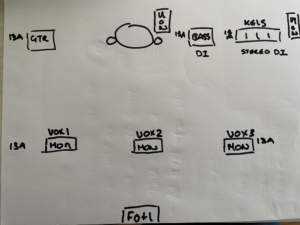
1. Put together a stage plot

This is a drawing of your setup on stage which should go to the booker or production manager ahead of your live performance.

As soon as you’re booked for a gig, send them this and they’ll pass it onto the venue/stage crew. The drawing should include where you need:

  • power on the stage
  • Direct Inputs
  • monitors
  • elements of drum kit noting if your drummer is left-handed for example.

This will save you time having to explain everything on the spot + it will help everything run more efficiently.

Your drawing should be Landscape orientation and it should fit on one page.

Most stage crew will stick them up on a wall backstage so it should be clear and easy to reference quickly.

2. Compile your tech requirements

If there are outstanding requirements not captured in your stage plot, send an accompanying list. For example:

  • Perhaps you’re going to bring your own in-ear monitors and will need an XLR OUT from the desk
  • Maybe you’ll need phantom power for a particular mic you want to bring
  • Any lighting preferences
  • Whether you’re bringing a sound engineer

Include a link to your music so technicians can get a sense of what you’re about. This can be really helpful.

All in all, your stage plot and list of requirements should capture:

  • what you have
  • where you have it
  • what you need to make your setup work

3. Ask for the venue’s tech setup

Ask your point of contact for the venue tech setup. This list of details should include what the backline is made up of.

If you want the venue to add anything to that, e.g., a specific amp, it could come out of your fee so try to use anything the house has to accommodate you.

4. Be cognisant of your rider

Venues will often offer you a rider, generally it’s a couple of beers and some bottled water. After that, any additional items you request come out of your fee.

5. Rehearse your changeover

You’ll be given a changeover time. This is you time you have to set up right before your performance, i.e., after a previous act has left the stage.

Make sure you arrive at the venue 2 hours before your changeover time and ensure you’re standing at the stage at your changeover time ready to go, guitar tuned/voice warmed up etc.

Rehearse your changeover. If your changeover is 20 minutes long, make sure you can do it in 10 minutes. Have your gear gone from packed to set up in that time and rehearse it before the gig.

If your changeover runs over time, every minute you delay eats into your set time, so perhaps drop a song if that happens.

6. Time your set rehearsal

Adapt your set so that it fits within your allocated time. Rehearse it and time that rehearsal. Any change of instruments or reorganising the stage mid-set should be captured within your allocated time slot so work this into your rehearsal. Stage crews deal in minutes.

If you have found that your set takes less time than what has been allocated to you, tell the booker ahead of time so they can plan accordingly. Any surprise changes to timings on the night will knock everyone’s time out.

7. Prep your gear

Prep your gear before arriving. Don’t have cables in a mess, have everything ready and labelled so it’s easy to take out, set up and pack away afterwards.

8. Introduce yourself

When you arrive at the venue, introduce yourself to the stage manager and ask to meet the sound engineer and lighting engineer so they know who you are.

Get the names of the stage crew and ensure they know you. You’ll likely develop relationships with these people and meet them again gigging.

9. Keep amps low on stage

Always ask for more in the wedge instead of tweaking your amp.

10. Always send a clean signal from the stage

The sound engineer will add EQ and compression to suit the house so leave your signal clean at the source. Go through pedals and any different effects with the sound engineer during your soundcheck.

11. Stage manager is the boss

The stage manager is getting feedback from all angles, across the venue so wait for their signal to go on stage.

If ever they tell you to stop playing, it’s for a very good reason. Perhaps there’s a serious accident in the audience. Always heed their direction.

12. Never show up under the influence

That will be remembered and you will get a bad name.

13. Don’t bring open drinks on stage

Everything on stage is needed by many performers. Don’t bring open drinks on stage, unless it’s a bottle of water with a cap on it. It’s a mark of respect to stage crews. Entire rigs have been destroyed by a pint and it’s dangerous.